Care Guide

A keeper's guide to tarantula husbandry
with AlienKeeper

AlienKeeper was built by tarantula keepers, around the everyday processes of keeping a room full of spiders. No app can tell you when your tarantula is hungry — that judgment stays with you. But the app can take a lot of the friction out of running a large collection. This guide walks through each feature and how it maps to real husbandry.

For keepers with 1–100+ animals Slings, juveniles, adults All species
Female tarantula kept and tracked in AlienKeeper
01 · Feeding tracker

Interval feeding
without keeping it in your head

Tarantulas are opportunistic eaters. Missing a week here or there is not a crisis. Overfeeding, on the other hand, can cause real problems. A heavy tarantula is more likely to hurt itself if it falls, and a fat one will often disappear into a burrow for weeks at a time.

Interval feeding works well for most species. The numbers below are a solid starting point, not a rule. The abdomen is still your best guide — plump means slow down, small means feed more often or try a larger feeder.

Slings every 7–10 days
Juveniles every 10–14 days
Adults every 14–30 days
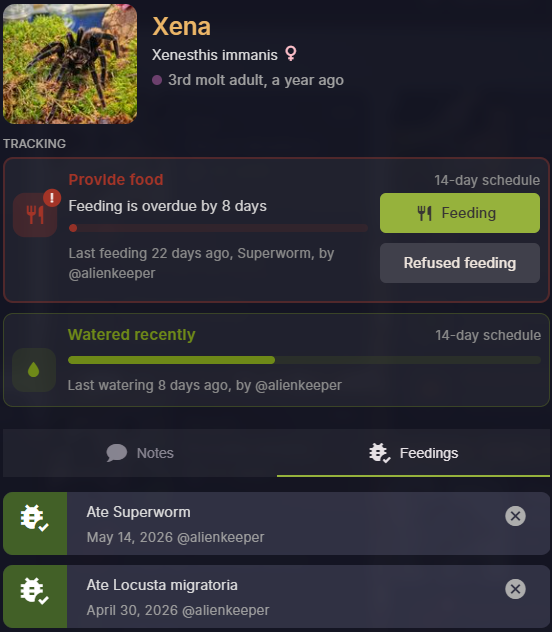
  • Set the interval per animal and the tracker handles the rest
  • Animals are sorted by hunger level — most overdue at the top
  • If a feeder is refused, set DND for 7 days and try again later
  • Every feeding is logged with the feeder used and whether it was accepted
Keeper note. Refused food left in the enclosure can stress a tarantula and damage it during molting. Pull live feeders within a few hours if they have not been taken.
AlienKeeper feeding modal showing what tarantula ate and if its hungry
02 · Feeder logging

Rotate feeders.
Catch problems early.

In the wild, tarantulas eat whatever crosses their path. Beetles one week, a grasshopper the next, a roach after that. Rotating 4–5 different feeder types at home gets you closer to that.

There's also a practical safety reason to keep feeding records. If a tarantula gets sick after a feeding, knowing which feeder batch was offered — and when — is a lot more useful than trying to remember. With a large group, identifying a bad batch before it affects more animals can matter a lot. Having the history is the convenient way to do that reliably.

  • Add your own feeder types — crickets, roaches, locusts, worms, anything you use — or pick from built-in feeder packs with common feeders from the hobby
  • See what was last offered to each animal at a glance
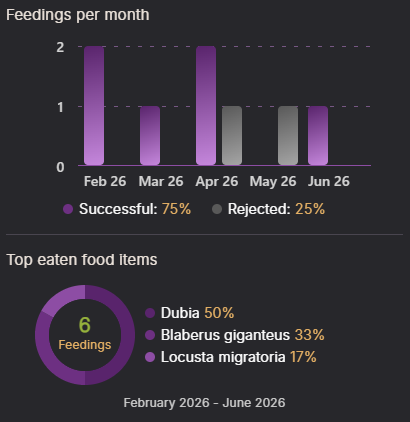
  • Spot acceptance patterns over time
  • If something goes wrong, the log gives you a starting point
Why variety matters. You would not want to eat the same meal every day. Different feeders also bring different nutritional profiles, which matters more than most keepers realize.
AlienKeeper feeder type chart showing which feeders were accepted or refused
03 · Watering schedules

Fresh water is
the cheapest insurance you have

Tarantulas get a lot of fluid from well-hydrated prey, but a water dish should still always be available. Water is critical during molting — they need it to push out of the old exoskeleton, and animals kept bone dry are far more likely to have bad molts.

The frequency depends on enclosure size, humidity, and dish size, but every 7–10 days is a reasonable default. Replace the water and clean the dish at the same time so bacteria do not build up. For most common species, an overflowing dish also gives you enough ambient humidity without misting. Asian arboreals and some other moisture-lovers are exceptions — check the species before you set up.

Why it really matters. A tarantula can hurt itself overnight. If hemolymph starts leaking and there is no water source, the animal can dehydrate before you find it. A full water dish is a safety net you give yourself time with.
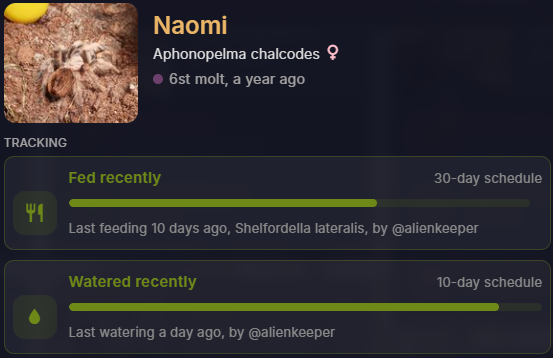
  • Custom watering interval per animal
  • Notifications so the schedule does not quietly slip
  • Full log of when each dish was last replaced and cleaned
AlienKeeper watering schedules
04 · Molt tracking & DND

Pre-molt, molt, post-molt.
Each phase has its own rules.

Premolt usually means refusing food, less activity, sometimes a sealed burrow. This is the wrong time to feed. Once you spot the signs, set DND (Do Not Disturb) on that animal so it drops out of your feeding queue, and pull any live feeders that are still in the enclosure.

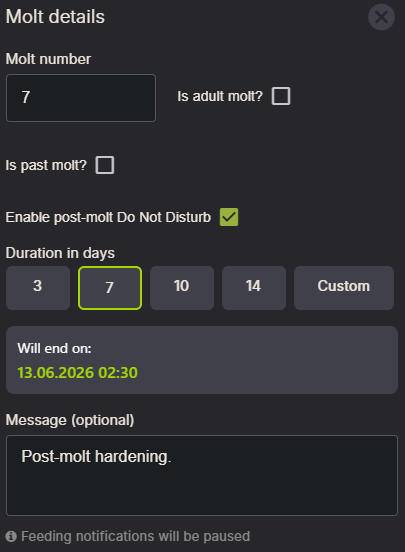
After the molt, log it. The same screen lets you set post-molt DND in one tap. Most species want 10–14 days of total peace while fangs and exoskeleton harden — no food, no handling. Fresh water needs to stay available the whole time, since they lose a lot of fluids during the process.

  • Premolt → DND on, remove live feeders
  • Molt → log it, add photos for memories
  • Post-molt → DND for 10–14 days, water always available
  • Full molt history per animal stays available forever
  • Why this is worth tracking. When you have 50 tarantulas at different stages, knowing who is in premolt, who just molted, and who is due to feed without a system is genuinely hard. The point is to get this out of your head.
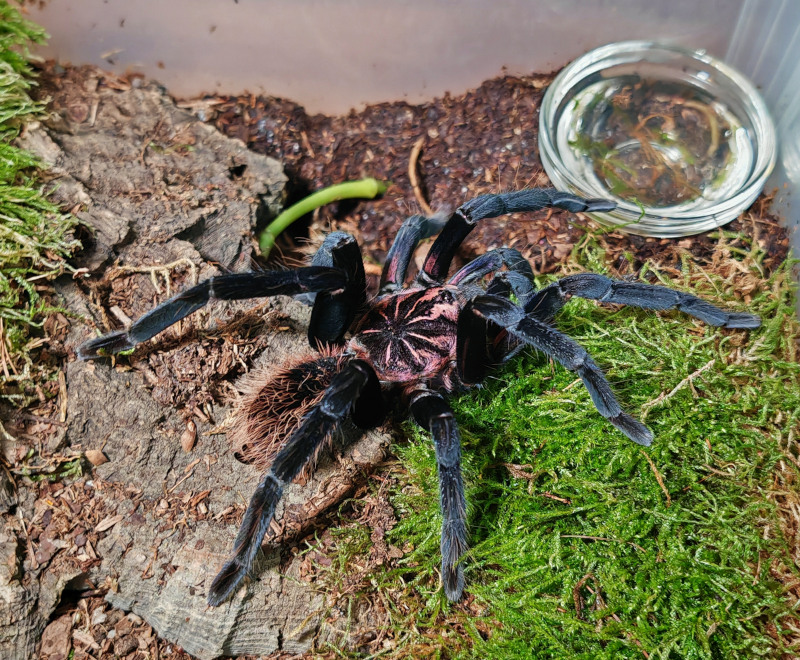
    AlienKeeper molt tracking
    05 · Behavioral charts

    What your logs
    start telling you

    Once you have a few months of feeding and molt records, the app starts showing trends. These are not gimmicks — they change how you think about individual animals.

    📊

    Feeding frequency

    Monthly acceptance rates per animal. When a tarantula starts refusing food more often than usual, that is sometimes the earliest premolt or overfeeding signal — earlier than the visible signs.

    🍽️

    Feeder preferences

    Which feeders does this animal actually take? Some tarantulas love lateralis and ignore dubia. The chart shows it. Use that to tailor what you offer.

    🔄

    Molt intervals

    How often does this species molt at this stage of life? How has the interval stretched as the animal has grown? The variation across species is honestly surprising once you see it on a chart.

    06 · Notes & sticky notes

    A place to write things down
    before you forget

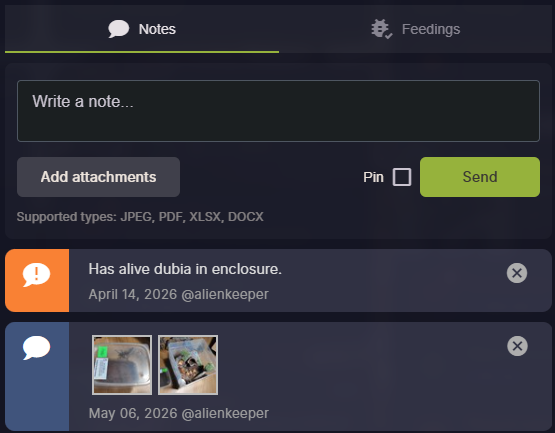
    It is hard to remember everything about every species, especially once you are keeping a dozen different ones. Notes give you a place to capture things as they happen — habitat ideas, enclosure dimensions, care tweaks you want to try, something you've heard on a podcast, something you noticed today.

    Sticky notes are the same thing, just pinned to the top of the animal's card. Use them for things that need your attention soon. A broken latch you have a temporary fix for. An injury you are watching. A rehouse you keep putting off.

    • Notes per animal, available on any device
    • Sticky notes for urgent things you do not want to lose
    • Attach photos to document an injury or enclosure issue
    AlienKeeper notes, sticky notes and file attachments
    07 · Files & research

    The care guide stays
    with the animal it is about

    If you are anything like us, you collect care guides, papers, studies and tarantula magazines and then lose track of them. They end up in random folders, downloaded, half-read, sometimes never even opened.

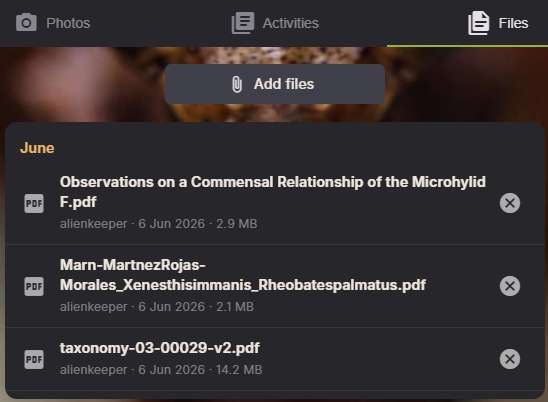
    Every animal in AlienKeeper has its own files tab. Attach anything you want connected to that specific tarantula. Next time you need it, you do not have to dig.

  • Per-animal files tab — keep references organized
  • Attach PDFs, excel spreadsheets, word documents
  • AlienKeeper files and research
    08 · Photo timelines & profiles

    A life journal,
    not just a tracker

    AlienKeeper gives every tarantula its own profile card. You do not have to track care to use it. If all you want is a place to keep photos and basic info, that works too.

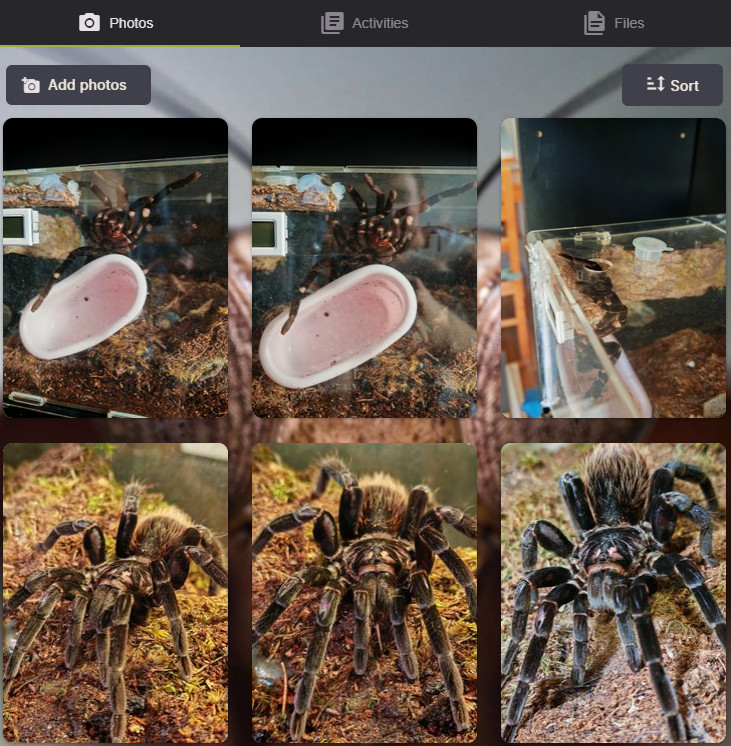
    One of the best things about keeping tarantulas is watching them change. A sling that arrived in a small vial turns into a palm-sized juvenile, then into a striking adult. Every molt changes them. Upload photos after molts, after rehouses, whenever they are out and looking good. Over time you end up with a real timeline of each animal's life with you.

    • Per-animal photo album, chronologically organized
    • Profile cards even for animals you are not tracking
    • Keep memories of animals you have rehomed or lost
    • Photos saved in the cloud, not in a phone camera roll of thousands
    AlienKeeper photo timeline showing a tarantula growing up
    09 · Cloud storage

    Cloud-first, not local.
    No backup anxiety.

    Most tarantula apps store everything in local phone memory. At best they offer a manual export. That works until the phone breaks, gets lost, or just dies — and the photos and feeding history go with it. AlienKeeper runs entirely in the cloud. Your data is encrypted, backed up automatically, and follows you to any device you log in from. There is nothing to manually export, and nothing to anxiously remember to back up.

    10 · Built for speed

    Designed to get out of your way

    Nobody wants to spend half an hour entering data. Every action in the app is built to be fast — logging a feeding should take a couple of taps, not navigating through five screens. That is the whole point.

    Common questions

    Tarantula care FAQ

    How often should I feed a tarantula?

    Interval feeding works for most species. Slings every 7–10 days, juveniles every 10–14, adults every 14–30. Use the abdomen as your guide — plump means slow down, small means feed more often or offer a larger feeder. They will not starve if you miss a week, but consistency helps with growth and condition.

    Why log which feeder I used?

    Two reasons. First, rotating 4–5 different feeder types gives your tarantulas a varied diet closer to what they would eat in nature. Second, if an animal gets sick, you need the feeding log to figure out which batch may have caused it. Without records, tracing the cause across a large collection is very difficult.

    How often should I replace water in the dish?

    Every 7–10 days is a reasonable default. Clean the dish at the same time so bacteria do not build up. The exact frequency depends on enclosure size, humidity, and species. For most common species an overflowing dish also handles ambient humidity. Asian arboreals and other moisture-loving species are exceptions.

    What does DND mode actually do?

    DND pauses all feeding reminders for that one animal. Use it when a feeder is refused, when you spot premolt signs, or during post-molt hardening. When the DND period ends, the animal goes back into the care queue normally.

    How long should I wait to feed after a molt?

    At least 10–14 days for most species, longer for big adults. The fangs and exoskeleton need time to harden, and feeding too early risks injury. Keep fresh water available the whole time. AlienKeeper can set post-molt DND directly from the molt logging screen so you are not tempted to rush it.

    Can I use AlienKeeper without tracking?

    Yes. Every animal has a profile card with photos and basic info. If all you want is a place to keep photos and species data, that works. The tracking features are there when you want them.

    Where is my data stored?

    In encrypted cloud storage. There is no local-only mode where you might lose everything if a phone breaks. Your feeding history, photos, and notes are available on any device you log in from, with no manual exports.

    Does the app cover species other than tarantulas?

    Yes. The same tools work for other arachnids, reptiles, and insects.

    This guide will keep growing as we add features and learn more from keepers using the app. If you have a husbandry workflow that should be in here, or a feature you want to see, the app has a feedback channel and we read everything that comes in.

    Give your tarantulas the care they deserve

    Track feedings, molts, and watering, build a photo timeline for every animal, and keep your whole setup in one place. No cost to get started.

    Sign up

    Free tier available · No credit card required

    Care needs differ from one species to the next, and covering those specifics is beyond the scope of this guide — its focus is on how AlienKeeper helps with particular aspects of keeping. It is not a species-specific care sheet and does not contain everything you need to keep an animal successfully. Always research the requirements of your specific species before you start keeping it.